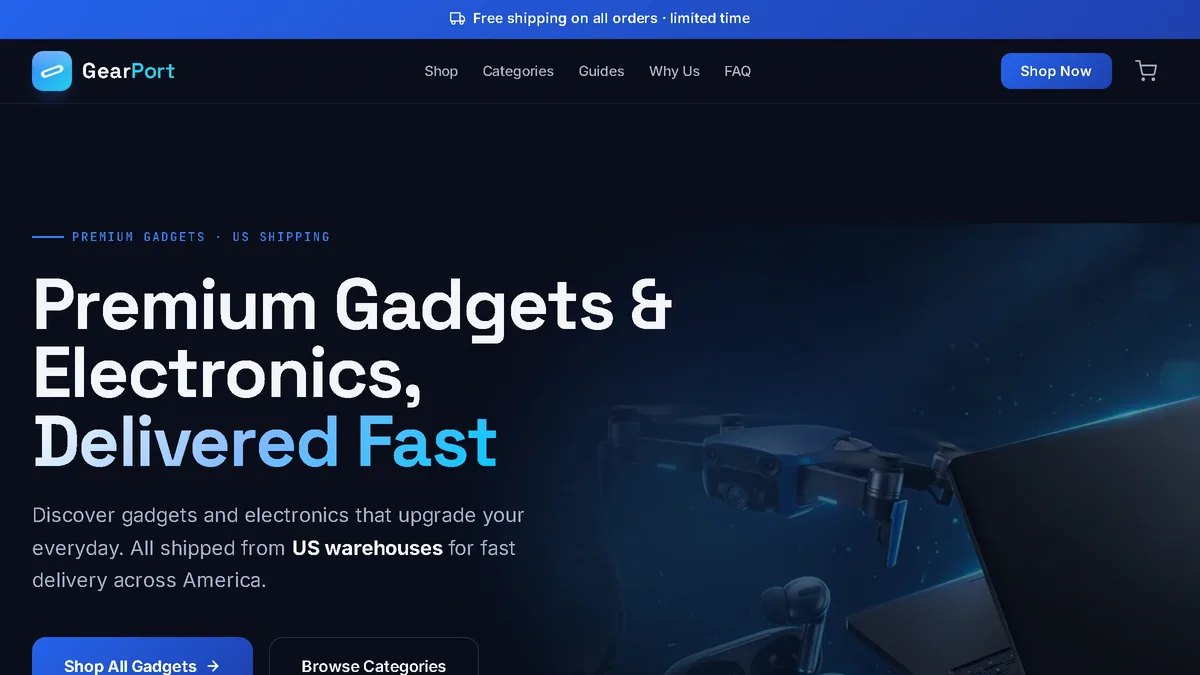
GearPort (www.gearport.us) is a Shopify dropshipping store example we designed and built for the US gadget and electronics market in June 2026. Products come from a US-warehouse supplier, Shopify runs checkout, and a custom storefront ties it together. Here is what the build delivered.
The goal
Build a complete, branded dropshipping store for a market outside Canada, with the supplier catalogue, stock and shipping handled automatically, and learn the US e-commerce setup first-hand.
What we built
- A complete brand in a day: the GearPort name (cleared against existing marks), logo, typography and a navy and cyan palette.
- A working commerce loop on day two: catalogue, product pages, cart and Shopify hosted checkout, verified end to end.
- Supplier-synced products. The supplier's app feeds Shopify; the storefront reads Shopify through the Storefront API, so no custom product sync was needed.
- Automated stock checks. A scheduled job walks the catalogue within the supplier's rate limits and sets each variant to sell only when the supplier reports stock.
- Customer reviews with moderation, search, and filters by collection, product type and price, plus a delivery-date estimator on every product page.
- A free-shipping switch: one flag drives every mention on the site, and an automated browser test confirms $0 shipping at checkout after each deploy.
- The site's own Vercel and Convex accounts from day three, with deploys from GitHub and every setting documented.
The results
- 161 pages with an on-page SEO average of 99 out of 100.
- Live and indexed in Google Search Console within three weeks of the first commit, with 2,123 search impressions across 768 queries in the first month.
- 187 commits over 32 working days, with the full feature set shipped in the first two months.
What it means for your store
A dropshipping store is straightforward to build well when the supplier connection, stock checks and shipping rules are automated from the start, which is exactly what GearPort demonstrates. What decides the business is the supplier: what they stock, where they ship from, and whether their cost leaves room under retail. We start every dropshipping project there. Our e-commerce web design page covers what a build includes; book a free consultation and bring your supplier list.