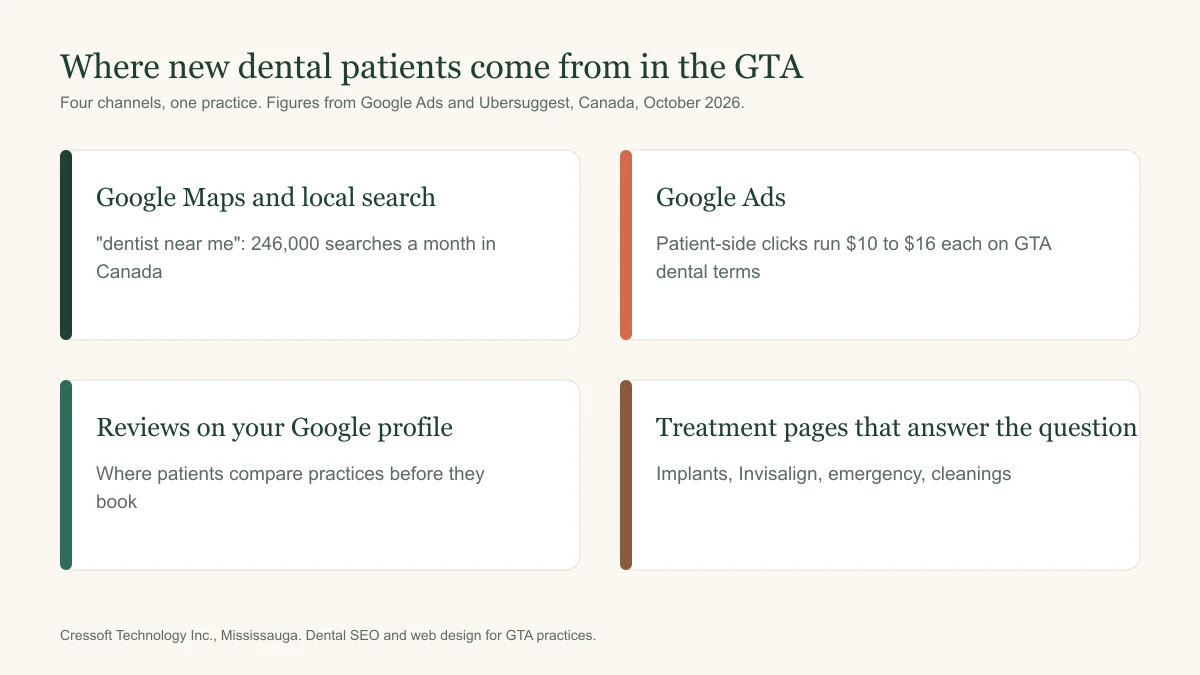
Dental marketing in the GTA is a local problem with four parts: a Google Business Profile that patients trust, a website whose treatment pages answer what people search, local SEO so the practice appears for neighbourhood and near-me searches, and Google Ads for the treatments where waiting for rankings costs too much. Everything else, from postcards to social media, sits behind those four. This guide explains what each channel brings in, what it costs in 2026, and what the Royal College of Dental Surgeons of Ontario (RCDSO) does and does not allow you to say.
Dental marketing is local, or it is wasted
“Dentist near me” is searched about 246,000 times a month in Canada, and almost every one of those searches is answered by a map. A patient in Port Credit is not going to drive to Markham for a cleaning. That single fact decides the strategy: the practice needs to be visible, trusted and bookable for the five to ten neighbourhoods it actually draws from, and it can ignore the rest of the country.
We audited a London, Ontario practice in August 2026 that had more authority than almost every competitor around it: 148 referring domains and a 4.9-star Google rating. It was absent from the first two pages of results for all six of the city’s core dental searches. The sites holding page one had authority scores between 4 and 17. Authority was not the problem. The practice had no page for any of those six searches, and it had the lowest review count of the nine nearest practices. That is the dental marketing problem in a single practice: being good is not the same as being found.
It also decides where not to spend. Province-wide campaigns, generic “dental marketing” retainers sold from outside the GTA, and content written for dentists in general all pay for reach you cannot use. The keyword “dentist marketing company” costs about $78 per click on Google in Canada; that number tells you how much agencies spend to find you, and it ends up inside the retainer of whoever bought the click.
The four channels that bring new patients
1. Google Business Profile and reviews
This is the map result, and for a dental practice it is the single most important page on the internet, more than the website. A complete profile (categories, services, hours, photos of the real office and team, booking link) plus a steady flow of Google reviews is what moves a practice into the three-pack for “dentist near me”. Reviews written by patients on Google are also the one form of social proof the RCDSO rules do not restrict, because they are the patient’s words on Google’s platform, not a testimonial you publish. Our Google Business Profile checklist and review-request system cover the mechanics.
2. Local SEO and treatment pages
Patients search the treatment, not the practice: “dental implants Toronto” runs 1,900 searches a month and swings between about 600 and 4,400 through the year. A practice with one page per treatment (implants, Invisalign, emergency, cleanings, children’s dentistry) and a page per neighbourhood it serves can rank for dozens of those searches without paying per click. The pages have to answer the question a patient types before booking: what it involves, what it costs or how pricing works, how long it takes, and how to book. This is the part of dental SEO that compounds.
3. Google Ads for the treatments that cannot wait
Paid search is the fastest channel and the most expensive per click. In October 2026 Google was charging about $15.55 per click for “dentist near me” across Canada, $10.59 for “dental implants Toronto”, and $9.78 for “family dentist Brampton”. At those prices a $1,000 monthly budget buys roughly 60 to 100 clicks. That is worth it for an implant or Invisalign case and rarely worth it for a cleaning, which is why we aim ads at one or two high-value treatments and let SEO carry the rest. Cressoft manages Google Ads at 15% of spend with a $300 per month minimum; the ad budget stays in your own account.
4. The website itself
Every channel above lands on the website, and most new patients land on it from a phone. The things that convert are unglamorous: a booking link visible on every page, a phone number that dials with one tap, office photos that match the Google profile, accepted insurance stated plainly, and a new-patient form that respects PHIPA. A site that loads in under two seconds on mobile and passes Google’s Core Web Vitals is table stakes; it is also where many older dental sites fail, which is why a redesign often comes before the marketing.
What dental marketing costs in the GTA (2026)
Published Cressoft prices, in Canadian dollars, no contract:
- Dental website, built with on-page SEO and booking integration: from $599 one-time, live in 2 to 4 weeks.
- Local SEO package (Google Business Profile, treatment and neighbourhood pages, citations, reviews, monthly reporting): $300 per month, promotional, regularly $500.
- Google Ads management: 15% of ad spend, minimum $300 per month, plus the budget you choose.
- Maintenance (hosting, backups, security, small changes): from $100 per month.
Cressoft Technology Inc. is not registered for HST, so those are the amounts on the invoice. For context on what the market charges, see our guide to how much SEO costs in the GTA.
The rules in Ontario: what the RCDSO allows
Dentist advertising in Ontario is regulated by the Royal College of Dental Surgeons of Ontario, and the rules shape what a marketing plan can say. In practice three limits matter most. No testimonials: patient endorsements cannot appear in your advertising, which includes your website and your Google Business Profile posts. No superlatives or comparisons: “best dentist in Mississauga”, “pain-free”, and “better than” claims are out. Nothing you cannot substantiate: fees, credentials and treatment outcomes have to be accurate and verifiable. Any agency that proposes a review widget on your homepage or an ad that says “top-rated” has not read the standard. In the London audit we found eight separate testimonial pages, each naming a patient, indexed by Google; nobody at the practice thought of them as advertising, and the regulator would. The marketing that works inside these rules is the same marketing that works anyway: clear treatment pages, a complete profile, real reviews on Google, and honest copy.
A 90-day dental marketing plan
Days 1 to 30, foundations. Complete and verify the Google Business Profile, fix the booking link and mobile speed on the website, and start a review request routine at checkout. Set up Google Ads for one high-value treatment with location targeting tight to your real draw area.
Days 31 to 60, pages. Write or rewrite one treatment page a week in answer-first language, add FAQ schema, and build neighbourhood pages for the areas you serve. Add the practice to the Canadian directories that matter for citations.
Days 61 to 90, measure and adjust. Read the Google Business Profile insights (calls, direction requests, booking clicks), the Google Ads cost per booked consultation, and Search Console impressions for treatment terms. Move ad budget toward the treatment that is converting; keep writing pages for the terms that are climbing.
Where Cressoft fits
We build dental websites and run local SEO and Google Ads for practices across Mississauga, Toronto, Brampton, Oakville and the wider GTA, written to the RCDSO standard from the first draft. The dental SEO and web design page lists what is included, and the free website audit is the fastest way to find out what your current site is costing you in new patients.